Sunday, February 18, 2018

Erik Killmonger: The Beauty of a Complex Villain


It’s been legit years since I’ve written on this blog but after watching Black Panther twice this weekend, I had to revisit it.

SPOILERS AHEAD

There are many reasons why Black Panther is such a great movie. Coogler manages to strike the exact right balance between action and emotion; the plot is rooted in a substantive story; and the characters are fleshed-out human beings with layers and complexities as opposed to caricatures or archetypes. The prominence of intelligent, strong-willed, personable black female characters and their integral contributions to plot, story and the very fabric of the film is nothing short of spectacular.

Like I said, it’s a great movie for different reasons and I could write an essay on each reason but this post is specifically about Erik Killmonger and the beauty of a complex antagonist.  

One of the many great things about Black Panther is that while it manages to be accessible to all audiences, it also speaks directly to black audiences whether in the diaspora or on the continent. The movie deftly explores continental African culture as well as African American culture both respectively and in relation to each other. The movie also addresses the various ways that white supremacy has enacted its oppression on black people whether it’s through showing the display of stolen West African artefacts in a UK museum 
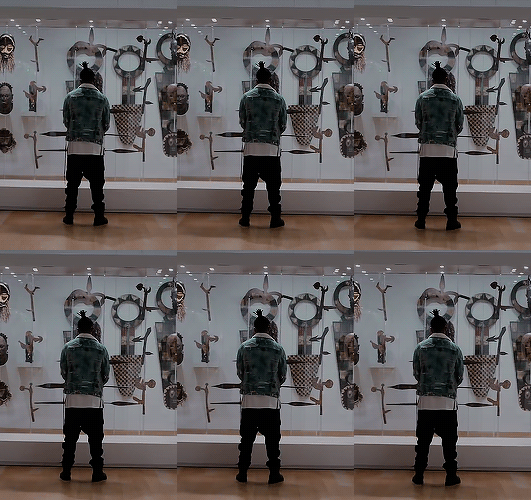
source: https://amberjliu.tumblr.com/post/171023030692/erik-killmonger-black-panther-2018

or the discussion of over-policing and inflated incarceration rates in the U.S. Anti-blackness is global and multifaceted and BP manages to show that with subtlety and precision.

Erik is an empathetic and layered character because while he is African American, he is also representative of the diaspora as a whole. While BP uses Wakanda to celebrate the various cultures in Africa, it uses Erik to explore the longing of the diaspora to reconnect to those same cultures whether it’s through him taking a mask from the West African exhibit 
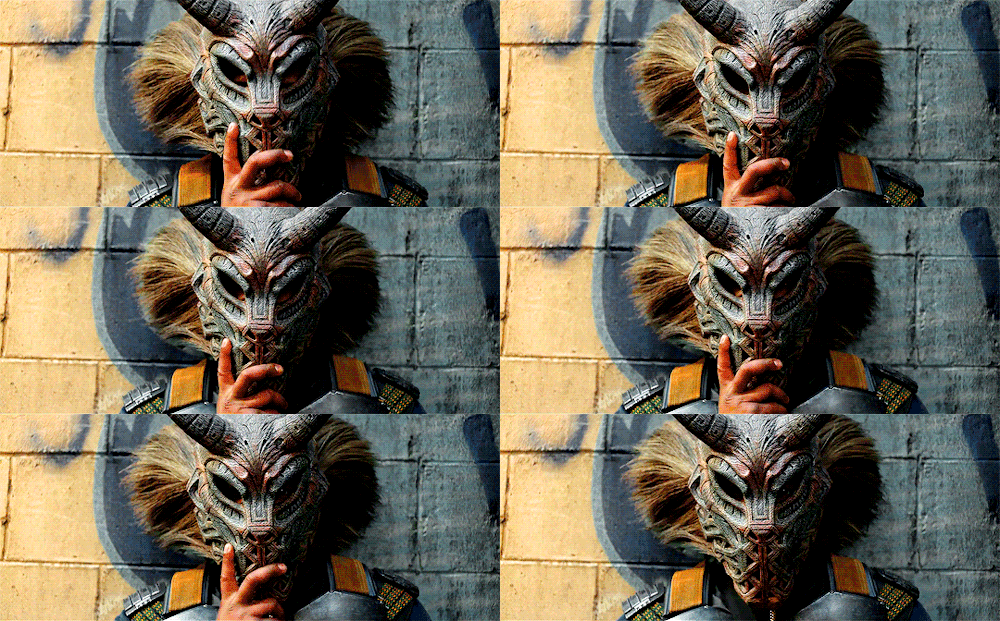
source: http://demonio-dos-pampas.tumblr.com/post/161648103138
 or through the revelation that at the beginning of the movie, it isn’t T’Challa asking T’Chaka about the origin of Wakanda, it’s Erik asking N’Jobu. More than that, Erik was raised in a society shaped by white supremacy and due to his career path, visited various countries around the world subjugated to that same white supremacy. So when he shows up at Wakanda demanding that they help their "brothers and sisters in need", explaining that black people have been subjugated and oppressed and started revolutions with next to nothing; when he shames Wakanda for their detachment, he is not wrong. At all.  However, what makes Killmonger an antagonist as opposed to a hero or even an anti-hero, in my opinion, isn’t his “by any means necessary” approach but the fact that his intention and his rhetoric actually don’t align.

Throughout Killmonger’s time onscreen I found myself nodding my head, muttering “he’s not wrong through” nearly every time he spoke. Yet I think it is made clear that he doesn’t actually intend for the oppressed to overthrow the oppressor, his intention is destruction. And no, I don’t mean “burn down the system and start from the ground up” destruction but complete and utter annihilation. 
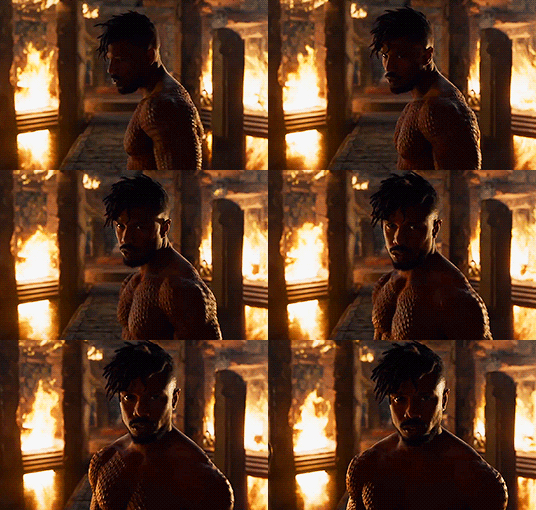
source: http://fallenvictory.tumblr.com/post/167853472722/ive-waited-my-entire-life-for-this
He admits as much during his final fight with T’Challa when he proclaims that the world has taken everything from him, everything he ever loved and this way they’ll be even. He speaks of arming Wakandan war dogs and the oppressed peoples of various countries but without formulating or discussing a strategy of any kind for the revolution itself or for what would happen after. He can only pronounce that Wakanda will rule over everything.

For me, it’s less about the fact that he was demanding Wakanda become the very thing he hates and more about the fact that the violence and toxicity and trauma of white supremacy broke him to the point that he couldn’t see anything outside of his own pain and rage. This is why the movie ends up agreeing with Erik’s rhetoric but not his intention. T’Challa not only faces his father and ancestors to tell them that they were wrong, he comes up with strategies and plans for Wakanda to actually reach those in need.

The tension between rhetoric and intention and the context of Erik’s intention is what makes him such a great antagonist. It is what allowed for my viewing experience in which I wholeheartedly rooted for T’Challa and yet empathized deeply with Killmonger. T’Challa was the hero I wanted to see succeed but the entirety of my emotional responses to the film came from Erik’s scenes. In other words, if you haven’t seen Black Panther yet, I recommend you check it out, right the hell now!

Tuesday, July 28, 2015

Cannot Believe It's Been A Year Since I posted But ...

... I really wanted to post this. To those of you who look in (if anyone) click on this link, comment, share, "react", see if there's anything you like :)
http://www.buzzfeed.com/zalr

Monday, August 19, 2013

When Do You Tell A Specific Story Right? (I wasn't clever enough for a witty title today...)

It's been a while since I've blogged, much less blogged about literature, but I got to thinking today. A while ago, I leant my friend Junot Diaz's latest book This Is How You Lose Her and she called me up to rant about it. This surprised me because she and I love Diaz's work; while Drown is expertly economic and sparse in its writing yet full of raw emotion and intensity, The Brief Wondrous Life of Oscar Wao is a beautiful masterpiece, a saga of colonialism, family, intergenerational trauma, nerdism, sexuality, identity and fantasy. Admittedly, when I had read his latest book in the fall, it hadn't spoken to me as strongly as his other two had but I found it superbly written and honest, an exploration of an older Yunior's psyche and views on relationships as a man. My friend didn't disagree but she said while in Drown and The Brief Wondrous his honesty was entwined with a commentary on these views, in This Is How You Lose Her that ironic/meta/critical element was gone. Yes, it is an unspoken (sometimes spoken) trend in Caribbean/Caribbean-American-Canadian/African-American-Canadian communities for black men to go after light-skinned women and see darker women on the side, yes power dynamics and sex can be entwined, but her issue was that the novel seemed to celebrate these issues and themes; This Is How You Lose Her seemed to take what made Drown and The Brief Wondrous stimulating, buzz-worthy, and sexy and run with it, revel in it, instead of stop and dissect it. I don't necessarily agree with this assessment but I found enough merit in it to think about it for a while since the same accusations were made about The Brief Wondrous. 

Many women I know found Diaz's female characters stock in comparison to the lively energetic voice of Yunior and the colourful characterization of Oscar; a lot of [white] women found the female characters unnecessarily harsh and unaffectionate; and other women (of many nationalities/races/ethnicities) felt as if he adheres to the whore/Madonna trope in all of his work. Certainly, the women are more subtly portrayed compared to the male characters in The Brief Wondrous but I never equated flashiness with depth; further, I understood the women in his novel because I grew up with and around these women. Their grit-teeth sternness, their suck-it-up attitude... they're survivors of horrific life experiences and are hardened as such; moreover, support for many Caribbean families isn't about emotion, it's about "getting shit done", about moving your offspring up in the world, providing for them, making sure they won't want for anything when they're older: financial stability, education, work ethic, an instillation of a "no-nonsense-nobody-will-walk-over-me-in-life" attitude and I think Diaz portrayed that unapologetically and wonderfully and my friend agrees with this. My point in bringing this up and explicating my defence of The Brief Wondrous is that it led me to another question (and this is where my post really begins): what does it take for commentary to work? If you're not writing an essay, if your fiction isn't explicitly polemical, if you're just trying to tell a story while at the same time making a comment on the world you grew up in ... how do you it? When and how is it successful? As a writer, I'm very interested in this question. It's almost related to the question about satire: when is irony not ironic anymore? As someone who witnesses "hipster racism" (http://jezebel.com/5905291/a-complete-guide-to-hipster-racism) daily, the irony/not-irony question is another one that really interests me.

I find myself constantly debating with people about when commentary in a story/movie/TV series works and when it doesn't or when it's nonexistent. For instance, I got in a heated argument with someone over Robert Downey Jr.'s use of blackface in Tropic Thunder. I felt like I understood what Ben Stiller was trying to do with RDJ's character: not only showing that Hollywood would rather "blacken" a white man rather than hire an actual African-American actor but that black characters in Hollywood films are presented as how white people see them and not as they are (the "collard green" scene did that for me). He, however, found that Stiller was using the defence I made as an excuse to get some cheap laughs at the expense of African Americans. On the other hand, I absolutely loathe New Girl. It's one of those shows I watch purely to hate (kind of like Sex and the City) and while a few of my friends have defended the never-ending racial jokes as a commentary on multiracial friendships in contemporary society, I feel like the show is just using racist jokes to make racist jokes under the guise of irony. I especially think this since the jokes or statements have nothing to do with the plots and they don't influence the dynamics in any way; plus New Girl still employs tokenism with Winston and CeCe rejects her cultural ways and for the few episodes that she embraces them, it's clear (to me) that the show is poking fun at the traditions.

There is no real conclusion or solution or realization in this post/to this post, it's really me just spewing out my thoughts and wanting to share them with whoever comes across this blog. I may have mislead you, the reader, into thinking this is about literature but I suppose I'm wondering more about storytelling and the politics/mechanics/influences of it. Spike Lee's Bamboozled does a great job in exploring the questions I've raised, making a commentary on when/how/why satire becomes real and therefore almost, ALMOST slipping into the caricature he condemns in his own film (which is interesting). So this more of a discussion than a definitive post and hopefully I get some [respectful] responses. And with that, I'll end.

Monday, April 8, 2013

The Message of Tyler Perry's "Temptation": Women Should Know Better.


Since Tyler Perry’s first movie I have had fundamental issues with his work firstly as a Black woman and secondly as a person who enjoys good films. In relation to the first part Tyler Perry has tropes and themes that permeate his films that personally offend me. For instance, there is a tendency to villainize the Black middle/upper-class; the men are abusive, controlling and emotionally domineering (Diary of a Mad Black Woman, Madea’s Family Reunion) and the women are manipulative and cruel (Madea Goes To Jail, Why Did I Get Married?) or just simply weak. The women, then, take a romantic chance on the unemployed man or the man with an arrest record because he is hardworking (whereas Black upper-class man aren’t) and has found God and is therefore redeemable. Another trope is the negligent mother who either ignores the molestation of her daughters or who purposely pimps her daughter(s) out to keep a man or who doesn’t have her child’s interest at heart (Madea’s Big Happy Family). However, his latest film Temptation: Confessions of a Marriage Counsellor has enraged me beyond any of his other films.

Quick plot synopsis: Judith is a therapist working at a matchmaking company. She is married to her childhood sweetheart Brice, a pharmacist, who has become increasingly inattentive to her throughout their marriage. Judith confides in Brice that she wants to start her own marriage counselling business but Brice urges her to put it off for 15 years until they’re more financially stable. Judith then meets Harley, a wealthy Internet entrepreneur who considers investing in the matchmaking company. Harley takes an interest in Judith and begins to seduce her implying that her sex life with her husband is bland and conventional, which prompts Judith to spice up her and Brice’s lovemaking, which is an attempt that falls flat. On a plane ride to New Orleans and back, Harley seduces her and they begin an affair, which eventually leads to Judith becoming addicted to cocaine, to quitting her job to start her own company (in which Harley is a partner), and to her leaving Brice and living with Harley where they engage in a volatile relationship in which he beats her viciously. It is then revealed that Harley is HIV positive, has a history of abusing women and giving them his disease. Brice then “saves” Judith but not before she contracts the virus. The end.

OK. My issue with this movie? Let’s start with the plane “sex” scene, which is actually a rape scene. What happens is Harley starts touching and kissing Judith, sliding his hands between her legs and Judith says “no” and “stop it.” She starts to cry and she starts to push him and hit him and her cries of “stop it!” get louder then he says, “OK stop it, stop it! Now you can tell people you resisted” and starts kissing her again and she stops resisting and the sex ensues. Before this scene was the one in which Judith attempts to spice up her and Brice’s love life by saying, “ATTACK ME, ATTACK ME LIKE AN ANIMAL” (previous to that Harley had told her sex should be “random like animals”). The plane “sex” scene coupled with the  “attack me” scene imply very irresponsibly that rape does not exist because women want it, crave it; we like being physically dominated but it’s “socially unacceptable” so we “pretend” to have real objections, so men just be men and push past the hitting, the crying, and the constant screams of “stop it!” and the woman in question will eventually succumb to her desire. This is how rape culture starts and gets perpetuated, this reinforces the idea of “she wanted it anyway” and so this is absolutely abhorrent.

My other issue is the message: BEWARE OF THE [Black] WOMAN WITH AMBITION. Certainly, Brice was inattentive and certainly Harley seduced Judith with flowers and private jets and (very stilted) sexual banter but he also seduced her with giving her a vote of confidence. He seduced her by telling her she should start her own business, she should be self-sufficient and the movie says, shame on her for believing him! If she had just listened to her husband and waited then she wouldn’t have contracted HIV! This leads me to my other problem with the film. It actually begins with a much older, frumpier-looking Judith counselling a couple. The husband states that he still loves his wife while the wife states that she was a different person when they got married at eighteen, people change and grow. The husband then leaves the session out of sad exasperation and Judith realizes that the woman has met a man who makes her feel exciting and wanted so she tells the story of her life as a cautionary tale while stating that this story is about her “sister”. When the story/flashback sequence finishes, the film moves back to the present and upon learning that Judith contracted HIV, the wife says, “Thank you for telling me this story. I’m going to end my almost-affair and stay with my husband.” So according to Tyler Perry and this movie, it is impossible for a woman to fall out of love with her husband and if she wants to start a new life she’s selfish and if she does, she will become addicted to cocaine, get beaten and contract HIV?

Furthermore, why did Judith have to change her clothes? Fashion and beauty play a big role in this movie. When Judith resisted Harley and remained a loyal wife, she dressed frumpily and then the more Harley seduced her, the more makeup she wore, the more flattering her clothes became and then after the affair, she reverts back to homely clothing. Consequently, good girls can’t wear makeup or flattering clothes because if they do, they’ll go sex-crazy and spiral out of control. The logic of this film and the conclusions it draws are absolutely ridiculous. Also what happens to Harley? Nothing! Brice beats him up and then that’s pretty much it. It’s Judith who has a lesson to learn, it’s Judith who should’ve known better, it’s Judith who should be punished because well, boys will be boys, men screw you over, it’s the way of the world, and she should’ve known! I mean, her religious mother had told her that Harley was Satan!

This film is also terrible on a cinematic level. It is pure melodrama with overacting and dun dun DUN moments with no nuance and no subtlety. First off the sexual banter was painful to listen to and was not at all seductive or appealing or charming or natural. “Sex should be random … like animals” made me cringe. There is also absolutely no chemistry between Jurnee Smollett-Bell (Judith) and Robbie Jones (Harley) and the entire movie was full of awkward stares and painful silences. Further, the whole Harley as Satan motif was pounded into the audience’s head what with his red sports car, the fact that the second time he and Judith have sex, they do so in the steam of the bathtub (so much steam in fact that all you see is steam) surrounded by lit candles, and oh yeah, like I said before, Judith’s mother literally calls him the devil. This movie took two hours of my life I will not get back.

Tyler Perry’s issues with Black women is not a subject that hasn’t already been parsed in the media but I felt compelled to write this post because I found this film irresponsible, deeply misogynistic and personally offensive. I have not been offended like this by a movie in a long, long while and I think the problems with it should be discussed in an open forum.

Friday, December 7, 2012

The Problems with The Vampire Diaries: More Than Irksome


I am a self-professed fan of The Vampire Diaries. Yes. I am. It’s endearing, funny – at times slick and witty – action-packed and I am obsessed with the love triangles it portrays. I will try not to bring any ship-war fandom into this post.

STELENA FTW!

Sorry, I couldn’t help myself.

But truly, this isn’t a Stefan versus Damon, Stelena versus Delena piece, this is about how while I tune in to the show every week and have been for the past 3 years, there are fundamental issues with TVD and they’re beginning to more than irk me.
            
Let’s start with the witch, Bonnie Bennett.
           
TVD has been running for four seasons now so the pattern concerning witches is well established: they have all been Black. The only exception to this pattern is Esther, the “Original Witch” who created vampires, and even she learned her craft from the Black witch who serves her family i.e. a woman enslaved to the family (The Vampire Diaries also glosses over enslavement while feeling self-satisfied with its subtle hints toward its presence in American history). I bring this up because most characters of colour have died on The Vampire Diaries – Anna, Connor, Luka and his father, Pearl, Bree – and if they haven’t died, they are there to serve the purpose of either helping or destroying the predominately white vampires. Nothing else.
           
Bonnie is the only character-of-colour who is in the forefront and even she is an incidental character. Indeed, she is integral in all of the supernatural creatures’ plots to either save Elena or themselves but she is not a character beyond her witchiness. They do not show her for anything else.  She is there to be used for her powers and nothing else and when she is so traumatized by an event that she can’t use them anymore, she’s told that she is not valuable (“The witch who has lost her powers is left out of the important conversations”).  It can be said that Bonnie’s character revolves around loyalty to her family, to her friends, and to, in a sense, morality and yet the only way she’s given to express that is through her magic. Caroline, Elena, Rebekah and Katherine are all given complexities and arcs that make them fuller characters. Caroline went from a neurotic, deeply insecure and seemingly shallow teenage girl to a fierce, loyal, mature and grounded vampire woman; Elena, driven by compassion and empathy is not a saint, she is selfish a lot of the time and victimizes herself to an irritating degree; conversely, Katherine who appears to be purely selfish and cold-hearted is also driven by love and loyalty; and finally, Rebekah, also deeply insecure, lonely, desperate and loyal channels her frustration through intense-vampire-bullying. Bonnie, however, lacks any of these interesting dynamics. It is not that she is a witch first, she’s a witch only; she is the contemporary Magical Negro there to serve at the pleasure of those around her. Magic is her only identity and she is the least protected character in the entire show – most characters have lost at least one family member throughout the course of the series – but Bonnie sacrifices, she and her family are the collateral damage 99 times out of 100 and she isn’t given the support of her friends.
           
This sort of segues into my next issue with The Vampire Diaries, which truthfully hasn’t been brewing as long as my Bonnie Bennett problem. As I mentioned earlier, The Vampire Diaries prides itself on giving its characters interesting dynamics so as to avoid creating stock characters (with the exception of Bonnie) and that is especially true for the two leading men: Stefan and Damon Salvatore. I will be focusing on Damon and particularly his relationship with Caroline.

Damon comes into the series as basically a psychopath who takes advantage of insecure girls, feeds on them, sleeps with them, compels them (erases their memory) and repeats – Caroline being his most prominent victim.  He also kills civilians to prove a point to his righteous, straight-laced little brother, Stefan, and tries to tempt Stefan’s girlfriend, Elena, into cheating on Stefan with him. Further, he tried to kill Caroline by draining her blood (Stefan saw to it that that didn’t happen) and he also tries to kill Bonnie and, again, Stefan saves her life.  It’s then revealed that Damon is pathologically lonely, fiercely in love with a woman (Katherine) who has led him on for over a century, ridden with suppressed guilt for the pain he has caused, and actually falls completely in love with Elena as she is someone who saw good in him and took a chance on him.

As the seasons progress, he becomes less and less psychopathic (even though his promiscuous and homicidal tendencies appear every once in a while) and allows his caring nature to shine through, mostly with Elena and with his brother, although with secondary characters too, such as with Caroline’s mother, Sheriff Forbes. In this season, Damon appears to be completely reformed and as a vampire, Elena has transformed into a different, more impulsive, “darker” woman. The two are finally together – yay for Delena fans, ehh for Stelena fans. However, Caroline reserves judgment on their relationship and takes jabs at Damon every chance she gets, which culminates into Elena vehemently defending Damon and paying no attention to his track record, criticizing Caroline for falling into bed with him in an instant and then ends with Caroline apologizing for her judgment.
            
Um, WHY SHOULD CAROLINE APOLOGIZE? The notion astounds me.
         
Indeed, Damon has changed. Elena and Stefan have both directly and indirectly turned him into a better man. However, the present doesn’t outweigh or erase the past. When Caroline transitioned into a vampire in season 2, all of her erased memories came back, which included Damon’s murder attempt and his emotional and physical abuse. While the show doesn’t directly acknowledge how Caroline feels about these memories or shows any real hostility in the Caroline/Damon relationship, Caroline is incredibly wary of Damon’s character and constantly pushes Elena to stay with Stefan who, does have a very bloody past, but who meaningfully atones for his past crimes and who has never tried to kill any of Elena’s friends. Caroline’s mistrust of Damon is well-founded and yet the show doesn’t appear to think so and constantly tries to counter her doubts so as to show Damon as a truly honorable person while forgetting or trying to make the audience forget that she has experienced a serious trauma with this person. It ventures into the Stephanie Meyer land of irresponsibility and is more than irritating and astounding.

Alas, I think I will end my post because if I go any further it will become a piece about how and why Stefan is better for Elena than Damon and that is not why I sat down and wrote this this afternoon. I am not completely writing-off The Vampire Diaries, it is a show I am completely obsessed with (probably a bit unhealthily so) but that isn’t to say that it’s not without some deep-rooted, real issues because it is, and they need to be acknowledged.

Monday, October 29, 2012

They're both Black ... So What's The Issue?


There have been many debates surrounding the choice to cast Zoe Saldana as Nina Simone in the upcoming biopic “Nina”. On the one hand, there are arguments for the casting choice, which essentially say Saldana is an excellent actress and a woman of African ancestry so what’s the issue? On the other hand, there’s an argument against the choice and it specifically takes issue with Saldana’s light skin and with the Hollywood tendency to “whitewash and lightwash a lot of stories, particularly when black actresses are concerned.”

            I agree with the latter argument.
            
This isn’t an attack on Saldana or on her acting abilities (although to be honest, the movies I’ve seen her in haven’t given her the capacity to exercise her acting skills for me to judge whether or not she is a good actress). However, I do take issue with the fact that rather than finding a dark-skinned actress who looks more like Nina Simone, the writers/producers/director have chosen to cast a light-skinned woman, fix her with a prosthetic nose, afro wig and – wait for it – darken her with makeup.
             
Sure. Actors and actresses have physically altered themselves to look like the characters they play; they dye their hair, gain weight, grow a beard, put on accents. However, none of those practices are rooted in racism and carry the emotional and historical and colonial baggage that blackface does. Yes. I do consider Saldana darkening her skin to look more like Nina Simone – who incidentally wrote “Four Women” a song about the histories and skin tones of four Black women – an act of blackface. Further, I find the choice an insult to Nina Simone’s legacy in that she did not adhere to what show business at that time deemed acceptable aesthetics and celebrated her dark skin and wide nose when she was told that those features did not embody beauty.

For more context surrounding the aforementioned Hollywood tendency, one just needs to take a look at Thandie Newton and the controversy surrounding her role in the film based on Ngozi Adichie’s “Half of a Yellow Sun”, which deals with the Nigerian Civil War; there is also the fact that Jacqueline Fleming, who is biracial, was cast as Harriet Tubman in “Abraham Lincoln: Vampire Hunter.”
            
As Tiffani Jones, founder of the blog Coffee Rhetoric, says: “When is it going to be O.K. to not be the delicate looking ideal of what the media considers blackness to be?”

Saturday, June 23, 2012

Ship Of Souls: A Novel of Revolutionary Nature

The best way for me to describe Zetta Elliott's novel is to say that it is revolutionary but not necessarily because it makes any overt political statements (although there are a few), but because it is a rarity; Ship of Souls is a Young Adult fantasy novel and all three of the protagonists are Black teens. In my experience, it is difficult to find a YA novel about Black teens much less a fantasy YA novel. As a writer, it is my goal to achieve what Elliott has -- and that is to write a story about human relationships wherein the characters happen to be people of colour. This leads me to discuss the book itself.

For those who don't know what the novel is about, the summary is as follows: a mysterious and supernatural bird takes three unlikely friends, D, Hakeem or "Keem", and Nyla on a "perilous journey that will take them from Brooklyn to the African Burial Ground in lower Manhattan, and into the very realm of the dead" (from the back of the book). Not only is the fantastical element of the novel both chilling and intriguing, Elliott masterfully balances the otherworldly with the banalities of adolescence. While D is coming to grips with the fact that he can speak to a bird, he also worries about impressing the beautiful Nyla, fitting in at school, and whether or not he's "Black enough"; issues that concern Black teenage boys as well as teenage boys of other racial backgrounds. Thus, Elliott succeeds in exploring themes that reach a specific (and often overlooked) target audience without excluding other readers.

The characters were also very enjoyable to read; D, Nyla and Keem made a wonderful dynamic since all three of their personalities were wildly different. I found myself drawn to Nyla's tough and independent nature and her sassy wit made me laugh on more than one occasion. While D is the main character, Nyla is the most active out of the three, and I was immensely pleased to read about a female character who was not passive in any sense and who didn't apologize for her personality or her beauty but who did not exploit her appearance either.

This is all to say that I read Ship of Souls in one sitting and while I deeply enjoyed the novel as a reader, I also deeply respected it as a writer. Zetta Elliott is a master of balance and nuance; she is able to use specificity to achieve universal appeal and I would highly recommend this novel for any young adult.

Saturday, December 3, 2011

I've Been Gone For A While ... Only To Reappear With A Little Self-Indulgence

http://www.cbc.ca/books/canadawrites/2011/11/writer-to-watch-zalika-reid-benta.html

Saturday, May 21, 2011

Invisible Women in Invisible City: The Issue That Isn't Acknowledged In Hubert Davis' Documentary

After hearing all of the hype surrounding Hubert Davis’ Invisible City, yesterday I decided to go and watch it for myself. While I found it a little slow-paced, I enjoyed the cinematography and thought the film did an excellent job in illustrating instances of systemic racism. A specific instance is when Mikey visits his guidance counselor and asks to be transferred from applied math to academic. Despite his B average in math, the guidance counselor questions whether or not he would be able to handle the workload in an academic class and keeps him in applied. Invisible City also provides an excellent example of stereotyping when interviewing Kendell’s basketball coach. The coach essentially said that he likes to bring boys from Regent Park onto the team for their inherent toughness and aggression. His comment reminded me of an article I had to read in my Grade 12 English Class that basically stated that while Black players have an inbuilt talent and “flow” for basketball white players are more strategic and tactical in their game. I remember being the only student offended by the notion and shut down by my teacher when I raised my contentions. But anyway, even with these necessary and illuminating scenes, Invisible City is fundamentally problematic for two interrelated reasons:

(Lack of) women and the portrayal of motherhood.

Granted, Invisible City follows the lives of two Black teenage boys: Kendell and Mikey. But there is hardly any representation or acknowledgement of Black teenage girls or Black women in the entire documentary. From what I remember, there are two instances in which the camera focuses on Black girls. One instance is when Kendell is playing basketball and a girl, presumably his girlfriend, is watching him play; the other is when Mikey’s sisters are studying and Mikey’s VO states that his mother doesn’t understand that his sisters don’t have to deal with what he deals with: racially prejudiced teachers, racist cops, and the temptation to follow his friends into trouble.

Both instances are loaded with issues. Mikey’s VO is his opinion but the documentary implicitly takes on the view that Black girls simply don’t face as many problems as Black boys. While it is true that Black girls aren’t confronted with all of the same problems as Black boys, there are plenty of racially-inspired hurdles that both genders face. For instance, Black women face just as many stereotypes as Black men. To name a few, we are stereotyped as being promiscuous, as being “baby-mamas”, as being loud-mouthed, and as being difficult and aggressive. Speaking from experience, teachers and authority figures do in fact label Black girls just as much as Black boys, their stigmatization predicated on the aforementioned stereotypes. Furthermore, Black women must deal with Western standards of beauty and must contend with the fact that we are represented as ugly in comparison to white women. A shocking example of this is the online article Psychology Today posted then deleted, arguing that, scientifically, Black women are less attractive because we have more masculine features compared to women of other races. Growing up with these notions of beauty and ugliness most definitely makes teenagehood for Black girls difficult and cruel and it is plainly wrong to suggest or imply that Black girls have it easy compared to Black boys. Our issues are merely different.


The shot of the girl watching Kendall play basketball bothered me because I found it to be a manifestation of a running theme in the documentary: that Black women are passive and bystanders to men’s lives. The portrayal of the mothers reiterates that theme, for the documentary doesn’t portray them as having active roles in their sons’ lives. Indeed, Davis illustrates that they love their boys and that they work extremely hard to provide for them but when it comes to their sons’ constant run-ins with the law and their inattention at school, the mothers’ vocabulary are filled with phrases such as “I wish”, “I hope” and “I pray.”


Furthermore, the mothers are put in stark contrast with Ainsworth Morgan, former pro-athlete and a local role model, who does actively participate in Mikey and Kendell’s lives, who talks to them “on the real” about how they’re screwing up their lives. He is essentially the father-figure to both boys and to other boys in the community – and he is the one who can put the boys in line. Now, I do think it is extremely important and absolutely necessary for Black men to take up their responsibility and parent their children – sons and daughters – but to suggest, like Invisible City (in my view) does, that Black boys absolutely need their fathers to teach them right from wrong, to keep them in line, to “be a man” essentially, is not only misogynistic, but a Western way of thinking.

But Davis isn’t the only director who takes this approach. John Singleton and Spike Lee treat Black women in very much the same way. While Boyz N The Hood and Do The Right Thing are fictional films, they still make commentary on the social conditions of Black boys and the Black community. In Boyz, Tre moves in with his father because his mother admits she can’t teach him to be a man. When talking about his other, fatherless friends, Tre’s father states that they have no one to teach them responsibility. The women in the film are either drug addicts, neglectful and cruel mothers, or they easily navigate the education system and experience no hardships or issues in their advancement. In Do The Right Thing, the women have a muted presence and are generally portrayed as passive.


Films like Boyz N The Hood, Do The Right Thing and The Invisible City are a good commentary on the social conditions of the Black community in North America, and they are good snapshots of what Black boys have to experience on the day-to-day. But they are incomplete in their commentary on the social conditions because they hardly acknowledge how Black girls deal with the conditions. All in all, there needs to be more films and more books (fictional and nonfictional) that deal with the experiences of Black teenage girls and the struggles and issues we must contend with growing up.

Saturday, November 6, 2010

The Lovely Bones: Garishly Sentimental and Blatantly Stereotypical

With the exception of Inception, the Pirates of the Caribbean series, and the Harry Potter series, I like to think I don’t watch movies because of the hype that surrounds them. Or I at least don’t watch them when the hype is still fresh. So I felt safe watching The Lovely Bones the other day considering that it has been about a year since the movie has been released. While I certainly did not like the movie, I can’t say I absolutely hated it. It is more appropriate to say that the film frustrated me.

Before I begin my rant I suppose it’s necessary to provide a brief synopsis of the film. Essentially, Susie Salmon, a fourteen-year-old girl, is murdered by her neighbour George Harvey. Instead of “moving on” to heaven, Susie stays in the “In-Between” world and watches as her family and murderer deals with and tries to move on from her death. When her murderer is brought to justice, when her family is no longer fragmented and when she fulfils her dream of kissing her crush (which she does in a very Ghost-like moment wherein she inhabits the body of another girl) Susie is able to leave the In- Between and go to heaven. The end.

Now, I haven’t read the novel and there is a good chance that I won’t enjoy it if I do decide to read it, but even so, I can still tell that the film is a bastardization of the book. The characters are one-dimensional, failing to portray the complexity of grief and of losing a child/sibling (VERY disappointed in Mark Wahlberg who I generally enjoy watching onscreen), the motives of the murder are nonexistent, making George Harvey a crude villain (although I do admit that Stanley Tucci does a great job considering the limitations of his character), the in-between world itself is garish and cartoonish, and the overtly sentimental tone of the overall film (exacerbated by the unnecessary narration and maudlin script) either forced me to change the channel for a few seconds or yell “PUH-LEASE” or “COME ON” at the TV. However, none of these aspects irritated me as much as the stereotypical character Denise Le Ang a.ka. Holly Golightly, a girl Susie meets in the In-Between.

I was upset by the fact that Denise Le Ang, an East Asian girl, is a type of “Magical Minority” character in that she just appears to Susie with knowledge of the In-Between and subsequently serves as Susie’s guide through this ethereal world, which is characteristic of Magical Minority characters, such as Bagger Vance (Will Smith) in The Legend of Bagger Vance and Cash (Don Cheadle) in The Family Man. In relation, I was irked by the fact that Denise was allotted the minority best-friend role. Although it is revealed by the end of the film that she was also a victim of George Harvey’s, throughout the narrative, she is given no back story, no desires, no wishes – her only goal is to help Susie move on from the In-Between and into Heaven. She has absolutely no personality or character. Even when the film reveals that Denise died at the hands of George Harvey, Susie finds out for herself and through her narration, tells the audience. Denise isn’t even given enough agency to tell her own story – a robbery that reminded me of Edward Said’s Orientalism in which he summarizes the maxim of imperialism as being “they cannot represent themselves, they must be represented.” I do not think such a reading of Denise’s character is too much of a stretch or too heavy-handed, for film does perpetuate these types of sentiments, perhaps unconsciously, but they’re still present and prevalent and they still come through.


It is true that overall The Lovely Bones is a one-dimensional and, despite the heavy subject matter, almost frivolous film that contains a variety of stock characters from the father, Jack Salmon, to the murderer, George Harvey, to Susie herself. However, none of these characters are stereotypical and therefore none of these characters are complicit in perpetuating typecasts and imperial limitations in relation to racial minorities. I cannot say the same for Denise "Holly" Le Ang.


Sunday, July 18, 2010

Sex and the City 2: Superficial, Racist, and just overall Bad

So this post was a long time coming. I meant to write it right after I saw the movie but I was sidetracked with school, work, exams etc. Anyway, here it is now. I’d be lying if I said I didn’t find certain things about this sequel humorous, but, I felt a strong sense of guilt and dirtiness whenever I laughed at a joke because, at least for the last half of the movie, a joke was made at the expense of another culture.

Before I get into this post, I suppose it’s important to quickly summarize what the movie is about or at least the part I will be focusing on.

The sequel takes place two years after the prequel. Carrie, Samantha, Miranda and Charlotte are all leading lives that are (supposedly) more stressful than before: Samantha, now 52, tries to keep her libido alive by using hormones and at the same time she must deal with menopause; Miranda chooses to quit her job because her chauvinist boss constantly shuts her down; Charlotte’s two daughters are a handful – the eldest is needy and the youngest constantly cries – and she’s worried Harry may have an affair with the stay-at-home nanny; and Carrie’s marriage to Mr. Big is in a rut as she wants to go out but he merely wants to stay at home, watch TV, and eat takeout.

Maybe half-an-hour into the film, Samantha is approached by an Arab sheikh to devise a PR campaign for his business, and he offers to fly her and her friends on an all-expenses-paid luxury vacation to Abu Dhabi where they are given attractive man-servants amongst many other ridiculously excessive “perks.” While in Abu Dhabi, many things take place: Carrie runs into her ex-fiancé Aidan; and Samantha, Charlotte, and Miranda run up against a culture clash in the Middle East, as their style and attitudes contrast with Muslim society but none more than Samantha.

My issue is with the way the culture clash was depicted because, really, Sex and the City portrays Western views as progressive and liberating while the Islamic society is illustrated as primitive and oppressive. When the four friends discuss Western men and Western society, they all agree that while men in the States like to think they’re progressive, they really want “us [women] to wear burqas around our face.” Thus the film is stating that Western men are not progressive thinkers because they secretly harbour a desire to conform to Middle Eastern customs.

How ignorant, arrogant and completely vile is that sentiment?

Near the end of the film, when the four friends rush to make their flight, Samantha’s purse drops and a bunch of condoms fall onto the ground in the middle of a marketplace. At seeing the condoms on the ground, a group of local men begin to aggressively berate her to which Samantha yells “YES. I LIKE SEX.” A group of local women, dressed in burqas, help the four friends escape the angry mob by pulling them all into a room in which they commend Samantha for her outburst. After which, they take off their burqas and reveal they are wearing Western designer clothes beneath their traditional dress. This was supposed to be an emotional, touching and empowering moment for women but really, it was incredibly offensive. The Arabic women are only considered empowered because they’re wearing Western fashion and conform – to what the movie portrays – as Western beliefs, because we all know it’s impossible for Middle Eastern women or men to be progressive in their own cultural context.

Furthermore, the film illustrates the Islamic culture as something that is meant to be gawked at and ripped a part. When Carrie, Samantha, Miranda and Charlotte first arrive at their hotel in Abu Dhabi, they go to the pool and make commentary on the burquinis (a burquini is a head-to-toe swimsuit that enables women to adhere to the Islamic dress code). If the commentary was merely informative then there wouldn’t be a problem but the commentary was meant to illustrate the swimsuit as ridiculous and oppressive and the audience was meant to laugh at the sheer ludicrousness of it. I honestly don’t understand how there has been no outcry over this movie!

And moving away from the blatant stereotyping, I don’t even understand how this movie is supposed to be empowering to women in general. Is it because the four protagonists are women? Is it because these women are sexual? Is that all it takes for a movie to be considered empowering to a female audience? None of these women have real problems to overcome! Charlotte has two daughters that cry a lot. What child doesn’t? She has a husband, a stay-at-home nanny, and she’s wealthy, and her problem is that she doesn’t have any time to herself? Puh-lease. As a child of a single mother, I was extremely insulted.

It really disheartens and angers me that the movies studios are making for female audiences consist of movies like Sex and the City 2 and the Twilight “saga”, for they are fundamentally problematic in more ways than one. That studios are also making racially prejudicial and offensive movies like Sex and the City 2 and Avatar merely prove the lack of progress we, as a society, have made in regards to race and other cultures, for film, like literature, is a mirror of the issues, prejudices, and concerns of the time and society in which it is made.

Sunday, April 25, 2010

Good Hair (film) Waste of Money and Lack of Sociopolitical Bearing: Forgets to Explore the Question Why

When I first heard about Chris Rock's documentary, I was extremely excited. Finally, a (somewhat) big budget film dedicated to intelligently exploring the dysfunctional relationship between Black women and the concept of "good hair." Unfortunately, I was immensely, nay, profoundly disappointed. I thought the title "Good Hair" would be ironic because Chris Rock would explicate why Black women resent their natural (and beautiful) hair and strive to achieve and maintain straight "silky" white hair. Instead, the title is ironic because Chris Rock (in my view) belittles, condescends, and criticizes Black women for spending large sums of money on achieving and maintaining "good hair." Chris Rock fails to realize or he merely disregards the fact that the colonial legacy in North America plays a fundamental role in the way Black women view beautiful hair and beauty itself. Frantz Fanon attributes this phenomenon to two processes - the lactification of consciousness and the epidermalization of inferiority - both of which are the interiorization of an inferiority complex due to socioeconomic depravities, and the desire to "whiten the race as if to become like milk" (pg. 47).

Chris Rock touches upon this only a little in that he interviews various Black celebrities and hairstylists who state that Black women want "Fara Fawcett" hair or "Bond girl" hair etc. The problem with this is that Chris Rock does not follow up on this by illustrating that natural Black hair is indeed beautiful and valuable. He does not show that some powerful and beautiful/sexy Black heroines in film do indeed have natural hair, such as Pam Grier's character Foxy Brown. Furthermore, what really disappointed me was that when he facilitated a dialogue in which a group of women told one group member who was sporting an afro that she does not look "put together" or "professional" enough to be a lawyer (for instance), he does nothing to contradict them. He doesn't even give the woman with the afro any screen time to respond to these criticisms. He doesn't even try to find the root cause as to why these women feel this way or try to find out how Black women have come to the idea that to look professional one needs to have straight hair.


In addition, I found "Good Hair" highly misogynistic in that Chris Rock treated the men in the film as rational, as the voices of reason while the women were foolish hair-buying fanatics. The film completely disregards the reality that Black men are just as particular about Black women having "good hair" as Black women are. Many of the Black men in the film did not seem to respect or sympathize with Black women especially since Chris Rock characterizes the men as the breadwinners or as the funding behind the trips to the hairdresser. And when he showed Black women getting their hair done (according to the film, the cost of weaves range from $1000 to $3,500) he felt the need to ask these women what they did for a living, which I found demeaning. I did not find the film to be an insightful text and I truly feel that the film provides white audiences with even more stereotypes regarding Black women. Since the film does not seem to have a point, I think it is a very dangerous possibility that whatever white audience the film acquired will leave thinking Black women are foolish and indulgent, while Black women will leave feeling belittled.


In the end, I found "Good Hair" superficial, insulting, and incredibly disappointing as Chris Rock fails to provide any insight regarding the reasons why Black women are so hateful and insecure about their natural hair. As the film does not problematize the term "good hair" and only the women who try to acquire it, I don't think it does the Black (female) community any favours.

Saturday, April 10, 2010

Black Children's [Canadian} Literature: Findings by Zetta Elliott

After Zetta Elliott, a Brooklyn-based African-Canadian author and educator, realized her books were not getting much attention in Canada, she decided to do some research and compile a list of children's books with Black protagonists. What she found was that the few Canadian children's books with Black protagonists available in bookstores or schools were written by white authors and the stories themselves did not take place in contemporary African-American communities. To take a look at her research follow the links below:

http://zettaelliott.wordpress.com/2010/04/06/numbers-dont-lie-do-they/
http://zettaelliott.wordpress.com/2010/04/05/stats/
http://zettaelliott.wordpress.com/2010/04/02/aint-they-black/

Saturday, February 27, 2010

Harlem Duet and the prospect of "Going Beyond Race"

I had to read Harlem Duet for class the other day and when we discussed the play in our lectures, there was a recurring element in the reflections of my predominately female, predominately non-black classmates and that was, they thought the play “went beyond race”. Most people in my class said something along the lines of, “Even though I’m not a black woman, I can relate to the feeling of a husband/boyfriend leaving me for another woman…” While I appreciate that level of empathy or understand how non-black women and men could enjoy or relate to the play, it irked me to hear the statement “went beyond race.” Why? Because it trivializes that aspect of the play – an aspect that is so integral, so fundamental to Djanet Sears’ literary work – and it trivializes the politics and struggles and injustices that come with race as well.

The mere fact that Othello gives Billie that impassioned, insulting, and hurtful speech about how white women are easier than black women because they do not emasculate and pigeonhole men or come home complaining about injustice in the workplace clearly demonstrates that this play is all about race. Othello’s speech indicates that he cannot stand to be with a black woman any longer because it reminds him that he is a black man; the injustices a black woman faces in the workplace reflect the injustices he pretends not to experience at his workplace. Therefore, his rejection of the black woman is a rejection of being black.

This is further demonstrated by the fact that upon reaching a certain level of professionalism, Othello leaves Billie for Mona. Certain people in my class found the “woman does everything for the man and then he leaves her for someone else” cliché albeit sad. And perhaps they are right. What they fail to realize though is that Othello leaves Billie for a white woman because he feels as if having a white woman by his side means that he has made it – he is successful, he is worthy.

Of course, Othello’s desire to be seen as a man, to live his own life without the burden of history, without feeling a certain obligation is understandable. But still, it is essentially impossible to sympathize with him and that is because to him, being “seen as a man” and “living his own life” means rejecting his heritage, rejecting his culture and assimilating into a dominant and racist society he deems worthier than his roots. He blames the black community for putting the burden of history on his shoulders; he does not blame the white society for forcing the black community to bear this burden. He criticizes the oppressed for being consumed with a history that has hindered them from advancing and does not even think about who gave the oppressed this history.

And I’m not saying Billie doesn’t have faults. She certainly does. She is so consumed with race that it drives her mad and she ends up in a mental institution. She is too preoccupied with the past to live life in the present. She cannot be consciously aware of her African-American history while trying to live her own life, she wallows in the history. So yes, she most definitely has flaws. But throughout the play, I found myself agreeing with her and most of her viewpoints. Othello is merely an extremely selfish, self-hating black man who has deluded himself into thinking that history has no or should not have any meaning.

In the end, my point is, Harlem Duet is not a play that “goes beyond race” because race and all of the politics that surround it is the central, essential aspect.

Friday, February 26, 2010

The Ambiguity Central to Do The Right Thing

I'm currently taking American Popular Cinema since the 1970s and it's a wonderful course. Many of the films that are on the syllabus are ones that I have seen, ones that I love, and ones that I am so incredibly happy to write essays about and to deconstruct in lecture. And while I have enjoyed studying films such as The Godfather, Breakfast Club, Thelma and Lousie, and Halloween in an intensely academic way, I knew that I would feel differently (not negatively) about Do The Right Thing.
Even though Spike Lee's film was made in 1989, it is just as relevant and just as contentious today as it was then and my lecture proved that. Most of my class sympathized with Sal and therefore viewed the film as one that incites and encourages violence. Conversely, I sympathized with the African-American characters and therefore I felt the opposite. I say 'therefore' because who you sympathize with in the film determines how and what you think of the ending and the film as a whole.
In my opinion, Do The Right Thing does not incite or encourage violence and those who think it does are taking the film in an extremely literal sense. When the Black community destroys Sal's Pizzeria after Radio Raheem's death, they are destroying an oppressive idea. Sal's Famous Pizzeria is representative of the exploitation of African-American neighbourhoods and I think while this is subtle, it is something that unravels throughout the course of the film.
For instance, the fact that Sal does not comply or even consider Buggin Out's demand to put African-American leaders/celebrities on the Wall of Fame demonstrates my aforementioned point. Buggin Out makes a very valid point in saying that since the Black community funds the pizzeria, there should be some sort of representation of clientele. Sal's absolute refusal illustrates his inability to acknowledge anything productive or great from the people he takes money from on a daily basis.
That Sal never once leaves his pizzeria signifies his lack of interaction with the community. He only puts up with Mookie's horrible work habits because as a delivery boy, he takes away that necessity. Sal's only interactions with the community are business-oriented and somewhat condescending. He does not want to get to know the people of the community, he does not want to help in advancing the state of Bedford-Stuyvesant - he only uses the Black community to his economic advantage. In other words, Sal is capitalizing off of a poor Black neighbourhood.
Consequently, I can completely understand the community's frustration and anger at the end of the film. Police brutality is what killed Radio Raheem, yes. But it was Sal's inability to represent his clientele, his disgust of hip-hop (an aspect of African-American culture) and his inherent racism that caused the events that caused the police to arrive. Meaning, that it was the exploitation and capitalization of the Black community that catalyzed the police brutality. So the community makes an attempt to destroy the exploitation and capitalism.
They [the community] have seen and been through enough that pacifism and passivity seem to be synonymous concepts and they feel as if it is time to take action. It is time to do things a different way, a more militant way, a more reactive way. And there is absolutely nothing wrong with that.
So I indeed will end with a Malcolm X quote:
"I don't favor violence. If we could bring about recognition and respect of our people by peaceful means, well and good. Everybody would like to reach his objectives peacefully. But I'm also a realist. The only people in this country who are asked to be nonviolent are Black people."

Saturday, January 2, 2010

The Brief Wondrous Life of Oscar Wao: The Great American Novel of the 21st Century

It took me a while to write this blog post because after I finished reading The Brief Wondrous Life of Oscar Wao, the only thing I had to say was that Junot Diaz's novel is absolutely, 100% amazing. But now I think I'm ready to explain why I think this book is one of the best books I have ever read.

Firstly, there is the narrative voice. From time to time there are shifts in the narrative voice but the story is written mostly from Yunior's perspective. I fell in love with Yunior's glib, devil-may-care tone when I read a short story, Fiesta 1980, from Diaz's debut, Drown (an anthology of short stories) and I appreciated it a lot more in Oscar Wao. Not only does this humourous narration make the book a highly entertaining read, it also allows for the reader to relate to the characters because, due to Yunior's slick and informal tone, they seem a lot more colourful and realistic even though the events these characters experience are quite extraordinary.

Furthermore, Diaz illustrates and opens up a world that is either familiar or unknown depending on who the reader is and what culture he/she comes from. I am not Dominican so I can't say anything for sure, but I feel as if Diaz is successful in explaining certain aspects of Dominican or Dominican-American culture without being "textbook" about it - and I'm not talking about the footnotes that are on certain pages - I am talking about Yunior's sly inputs during the course of the story.

I also found Diaz's continuous references to Lord of the Rings highly entertaining and surprisingly highly relevant. In fact I watched The Two Towers immediately after finishing the book. I also enjoyed the postmodern aspect of Oscar Wao and finally, throughout the book I found various passages and quotes that will add to my list of "favourite quotes" on facebook (I just HAD to bring facebook into one of my posts, I know).

In the end, I am absolutely in love with the Brief Wondrous Life of Oscar Wao, I find Junot Diaz to be an author of extremely high calibre and I look forward to reading whatever novel he writes next.

Saturday, December 26, 2009

Avatar: A futuristic movie filled with old-fashioned ideas

I’m not really one for science fiction but after all of the hype surrounding James Cameron’s Avatar, I had to see it for myself. I have to admit the movie was visually appealing (even if the 3D glasses I was forced to wear blurred my vision rather than enhanced it) but I found the story itself unoriginal and more importantly, I found the way in which the Na’vi race was portrayed problematic.

Yeah, the Na’vi are blue but their faces are a melting pot of ethnic features and their long hair is dreadlocked. Plus, the main Na’vi characters are voiced by four black actors (Zoe Saldana being the prominent Na’vi character and love interest to the movie’s white protagonist Jake Sully). Consequently, it is not enough that the Na’vi are meant to be an extraterrestrial race – no, Cameron must further emphasize the “other” aspect of these fictional people by giving them recognizably ethnic features and by having black actors portray them.

Now, I know that Avatar is meant to be symbolic; that it is supposed to be a reflection of the imperialistic and colonial exploits of our world (Cameron admitted this himself in an NBC interview stating that the plot is centered on how greed and imperialism “tends to destroy the environment” and so on and so forth). And I think that if Cameron had done it right, I would have appreciated it. But Cameron did not do it right. He merely perpetuated tropes and themes that have negatively or condescendingly portrayed other races. For instance, before the (white and for the most part middle-aged) humans officially declare war on the Na’vi, Sully inhabits his Avatar and desperately attempts to make a diplomatic agreement between the two races. But of course, the Na’vi ignorantly ignore his advice and believe that their bow and arrows will take down the humans’ advanced machinery. And when that doesn’t work, Sully becomes one of the Na’vi people and leads them into battle because for some reason, the actual leader of the Na’vi can’t seem to do it himself. Therefore, Cameron adds to the vast amount of literature and movies that portray the need for the white man to rescue an ethnic race because they are not intelligent or strong enough to overcome extraordinary obstacles themselves.

Of course, that isn’t the only contentious detail. The way in which the Na’vi are portrayed as the “primitive other” is also problematic, for while the film tends to praise the Na’vi people for being in touch with nature, the fact remains that these fictional and yet recognizably ethnic people are inherently bestial and are meant to be the antithesis of refinement and civilization. Cameron doesn’t depict civilization as being a particularly good or moral place but he still depicts civilization as something that is Western.

It is in my opinion that Cameron’s heart was in the right place when he made this movie but it is also my opinion that the story was hackneyed, that it lacked insight, and that it was filled with Western arrogance.

Thursday, December 10, 2009

Beloved by Toni Morrison: A brilliant book about Trauma

Today I was engaged in a debate that I've been having for two years now. It is a debate I always welcome with anyone and it concerns a topic I'm very passionate about. While Toni Morrison's Beloved won the 1987 Pulitzer Prize, many of my friends and fellow students believe the novel is undeserving of the award, that it is far too pretentious, and that it is a vanity piece in that it merely displays how clever Morrison is.

I respectfully disagree.

Toni Morrison is my favourite author and Beloved is my favourite book of all time (Drown by Junot Diaz is a strong contender). While I can hardly call the writing simplistic, I refuse to acknowledge it as pretentious. I believe the writing is intelligent and that if the author were a white man rather than a Black woman and if the book's subject had nothing to do with enslavement, it would be considered as such. Of course, I have heard theories that Morrison only won the Pulitzer because of the fact that Beloved is about enslavement; these theories usually come from my white friends who find the book an uncomfortable/frustrating read because they feel as if the book is merely "another" story detailing how white people have marginalized and "screwed over" (as they say) African Americans. My response to them is twofold.

One: enslavement is a very big part of American history and it is not an event you can merely wish away just to make yourself feel more comfortable; it is not an event we should or can forget especially since the traumas of enslavement are ongoing considering that even today, African Americans are very much a marginalized group. Second: the purpose of Beloved really isn't to point fingers. It is a book about trauma. I cannot stress this enough. The novel is about how a Black family, how a Black community, tries to find happiness, independence and identity but the effects, the traumas, and the mere memories of enslavement constantly hinder their attempts to advance. Beloved concentrates on Black characters and details the ways they try to cope with a horrific experience that psychologically and emotionally broke them; the depravity of the white "slave" masters is not the focus.

But even if the inequitable and barbaric power dynamic between the white masters and Black enslaved peoples was the focus, that should not and would not render the novel bad. For those who think it would, perhaps they should analyze why they are unable to read about a book portraying true historical facts.

Tuesday, December 8, 2009

The Problem With The Tale of Despereaux

I just finished watching The Tale of Despereaux and while I find the movie visually engaging and the "mice are cowardly" theme cute (even if it does become hackneyed over the course of the film), I just cannot get over the way "Ratworld" was introduced. As in many books and films, rats in The Tale of Despereaux are depraved and vicious creatures. As if to heighten these characteristics, when the film first displays the squalid Ratworld, it does so over a score of African drum beats and Arabic melodies. The blatant racism behind the fact that this music is meant to invoke a sense of barbarism and savagery is atrocious and detestable. Exactly what message is this movie sending to its child audience? And for those who believe that deconstructing the music of an animated film is ridiculous and that I am merely going "PC crazy," I have two things to say. Firstly, I HATE the term and the entire concept of "politcal correctness" because it does not eradicate or solve anything - it merely asks a racist/misogynist/bigot to cloak their views. For instance, if a racist wants to refer to a Black person as a "nigg--" but says "African-American" to uphold "political correctness," said racist is still calling the Black person a "nigg--" in his/her mind and still has the same views. Secondly, nothing in film is an accident and so the responsible thing to do when presented with a situation such as the one in the Ratworld scene is to question why did the composer/director choose to use African and Arabic musical tones to introduce a world that is meant to represent debasement, primitivism and vulgarity? What implications does this choice have? And why, in this day and age, is the concept of the primitive other one that is still very much alive?

Sunday, December 6, 2009

The Danger of Twilight

Two nights ago, I went out with my friends to celebrate my 19th birthday. But instead of going to a club (as was our original plan) we ended up losing ourselves in conversation about certain television shows, movies, and books (you know you're an English major when ...) And a bulk of our conversation consisted of the danger and flimsiness of Stephanie Meyers' Twilight "Saga". Admittedly, we had all read the books and had gone to see the films (in fact the conversation started with us admiring the built of Taylor Lautner and the Jacob Black persona). However, I believe that the fact we have read the books and have seen the movies allows us to criticize the books more thoroughly and more productively than the people who merely state they hate the franchise. What I realized is that when I read New Moon, I did find some things problematic but when putting the book on screen, all of those probelmatic aspects become heightened and emphasized. The mere concept of a teenage girl going on suicidal endeavours just to "see" her estranged boyfriend or "hear" his voice is not only ridiculous but socially regressive. That Bella's character is not able to take care of herself and relies on another man (Jacob Black) when her boyfriend (Edward) leaves is also extremely problematic - why is it that the only strong female characters in the novel are vampires? Furthermore, the relationship she has with Edward is completely unhealthy as he is possessive rather than protective and that they are willing to die for one another since life without one is meaningless is for, lack of a better word, completely insane. And while Bella's relationship with Jacob Black is normal, human and "natural" he still manipulates her into kissing him by threatening to commit suicide (seems to be a theme prevalent in the series). However, what I find most disturbing about everything mentioned is that while my friends and I are able to deconstruct the series and pick out what is problematic (due to being young women) the little girls who read these books find them romantic and want to grow up to be Bella and attract men like Edward (who is literally the "unattainable male character"). I am not saying that Twilight should not be read but I am saying that despite being a superficial book, it is one that should be taken with a grain of salt.